

From Horseback to Centauri
When instant communication ends, what will replace it?

The modern world is circumnavigated by messages millions of times a day. While it is one of our greatest accomplishments, the era of instant communication will not last forever.
In 1857, the philosophical naturalists Charles Darwin and Alfred Wallace exchanged letters. The contents of these letters would form the basis for the theory of evolution by natural selection. They are some of the most impactful correspondences of the last two centuries, sculpting out of their observations the pillar of modern biology.
A horseback rider crossing Europe will seem hasty to those awaiting word from Proxima Centauri.
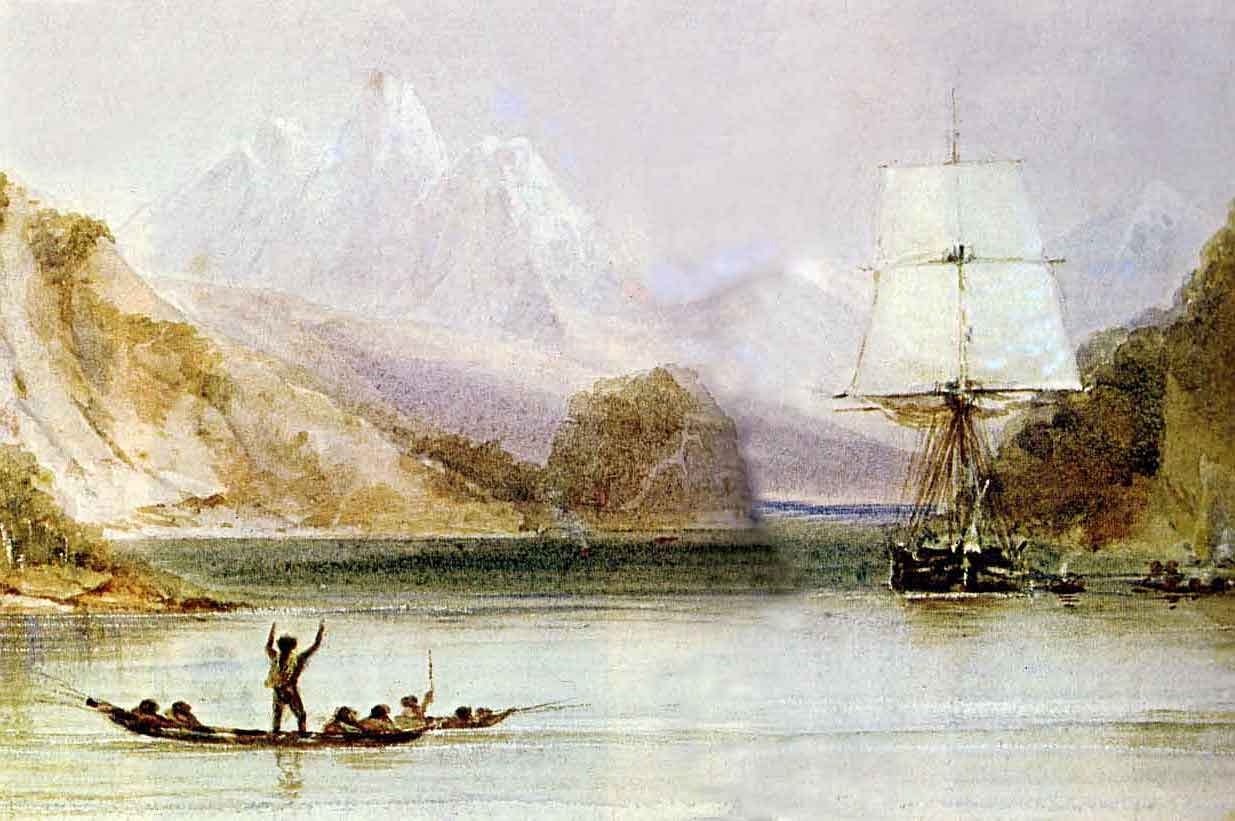
These letters were carried by horseback throughout England, and by boat around the world. Letters to collaborators between London and Paris would travel hundreds of kilometres - while Darwin’s sketches from the Galapagos would travel thousands. One way correspondence in this era was days to months, depending on the distance.
For much of history before Darwin and Wallace, this was the speed of communication. Information across the world was limited to the speed of the horse, roughly 10km/hr. Shortly after them, it would be nearly instant.
Wired to Wireless
Harnessing electricity began at the turn of the 19th century. With wielding of current came the first long distance message system in the 1830s: The telegraph. Meaning “to write at a distance”, it uses an electrical signal along a continuous wire from sender to receiver. Using Morse code, scribes turned any message into a series of long and short pulses to be passed along the wires at nearly the speed of light.
The interconnectedness of humanity will begin to fade as we travel further into space.
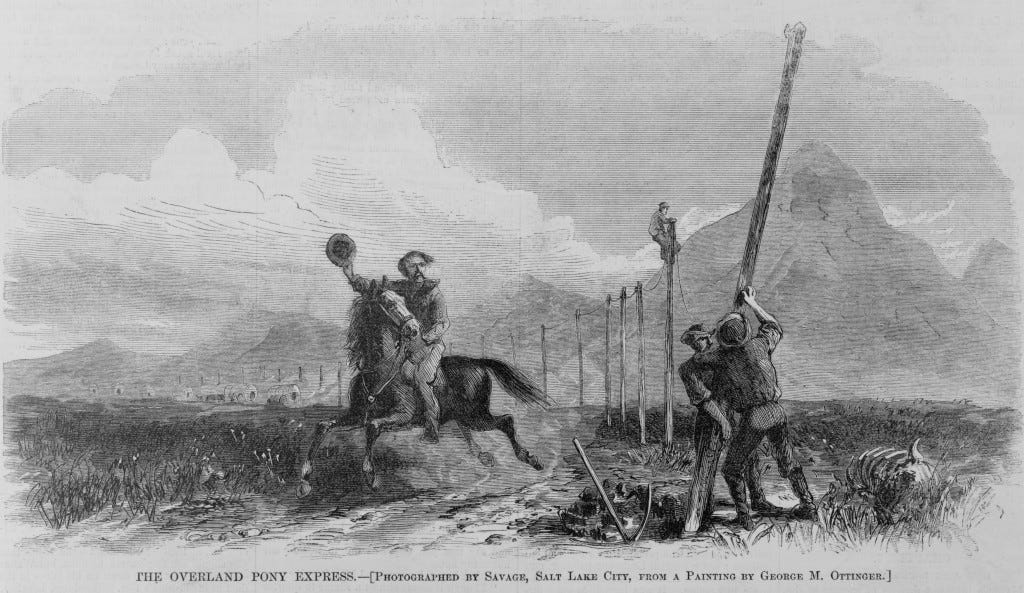
Electricity is the movement of electrons through a medium. Along the surface of steel and copper telegraph wires, electrons move at speeds approaching the speed of light (approximately 10^9 km/hr). Letters on horseback at 10km/hr, to messages nearly the speed of light: A 100 million fold improvement.
Telegraphs require continuous solid connections which are challenging to run long distances. In 1901, half a century after the first telegraph message, physicist Marconi sent the first trans-Atlantic wireless transmission. No longer were our communications constrained by undersea cables or long distance wires: The invention of the radio began the 20th century.
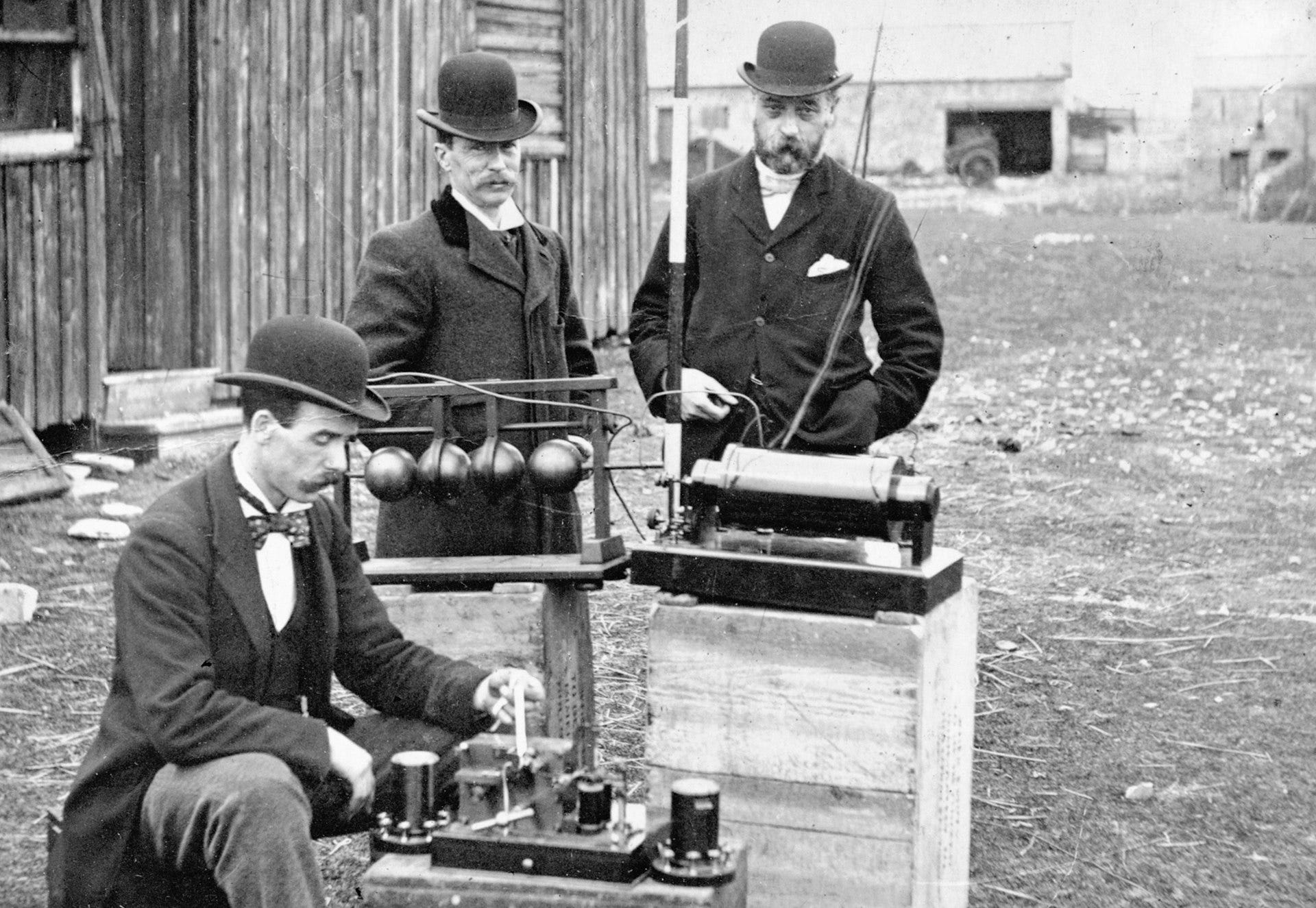
Through the 1800s, communication went from letters on horseback to wireless transmissions at the maximum possible speed. Communication speed was a step function (not unlike the ones used by Marconi). There was no intermediate phase, we went from limited to instantaneous.
As our descendants make their way to the outer solar system and beyond, the rate of communication will steadily decline.
Will the instant era come to an end?
The speed of light is slow. Light in a vacuum travels at 3 x 10^8 m/s. This is (to the best of our understanding) the fastest any information can travel. Since the harnessing of radio, we have reached the universal cap on the speed of our signals.
As we head out to settle other planets, we must confront the scale of the cosmos. At their maximum separation, a radio signal from Earth to Mars can take 20 minutes. A 40 minute total time lag in conversation is enough for daily tasks, but draws us backward to the era of Darwin and Wallace.
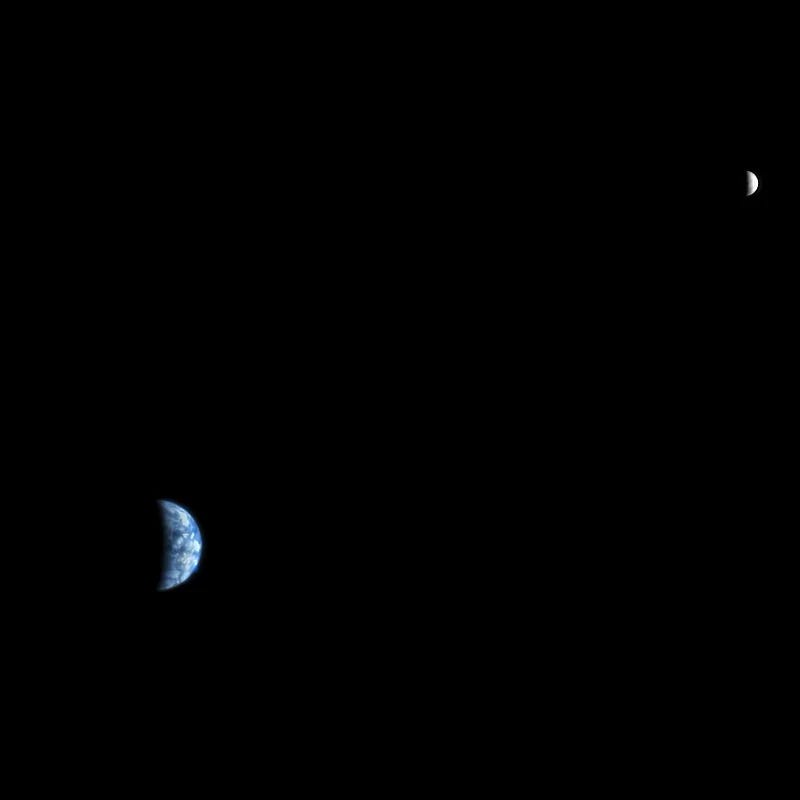
By Jupiter, that one way signal takes nearly 1 hour, at Saturn 1.5, and over 4 by Neptune. A pair of scientists exchanging ideas between Earth and the outer planets will have their correspondence limited by distance. Each step deeper into space requires more powerful and more accurate antennas as the targets become smaller in each respective sky.
To go beyond the solar system is to find ourselves at another step function. The nearest star to Earth is Proxima Centauri, and it would take a radio signal over 4 years to reach it. A message home from the orbit of Proxima Centauri would arrive 4 years after its author sent it, and an immediate reply would take another 4 to return. A horseback rider crossing Europe will seem hasty to those awaiting word from Proxima Centauri.
Radio Silence
The luxury of instant communication is what binds the modern world. This interconnectedness of all humanity will begin to fade as we travel further into space. While the population on Earth will remain instantly intertwined, those off world will slowly lose closeness. Coupling the increasing time lag with mounting engineering hurdles, the contact burden becomes costly.
Alfred Wallace died in 1913. He lived long enough to enter a world where wireless broadcasts carried ideas in an instant. As our descendants make their way to the outer solar system and beyond, their rate of communication with home will steadily decline.
We are born into the epoch of instant communication: Will we live long enough to see its end?

I once wrote a story (The Cloud) about the building of what I called the Star Way between Earth and Alpha Centauri. This was a laser-powered solar sail transportation system with a giant lens every 100 AU to refocus, and sometimes renew, an equally giant and powerful beam of laser light from the sun (it wasn't my idea, I got it from a scientific paper). Anyway, one of the interesting complications that came up in the story was how do you manage a corporation (the one responsible for building the relay stations) when communication to the office stretches from months to years? Just depicting the time lag between Earth and the fieldwork became a bookkeeping challenge. It became obvious to me that authority would have to devolve to the local level to keep such a project on track. Probably, we are back to systems such as the Romans used to maintain their empire.
This is my fav piece so far Max!