

Tied Down in Time
Will we ever stop tying knots?

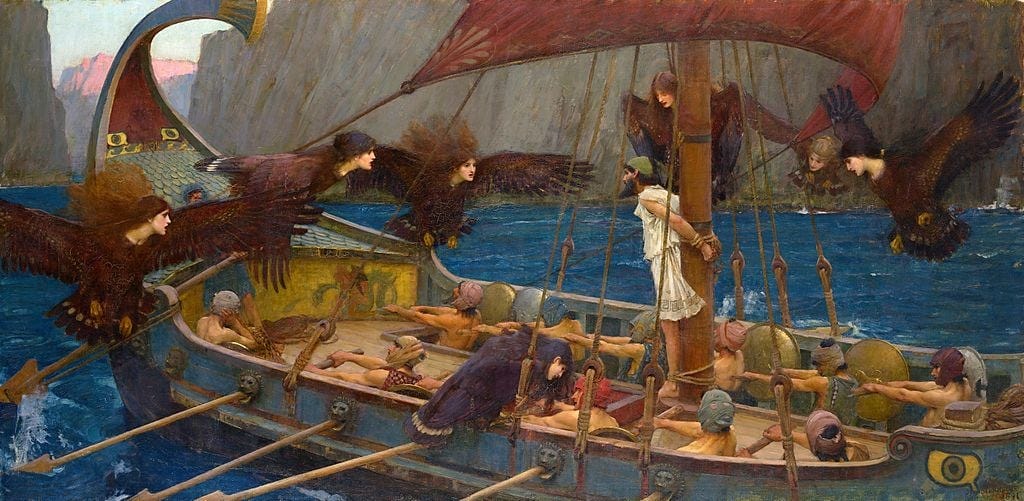
When Odysseus heard these words, he at once fitted on the lid, and quickly fastened a cord upon it—a cunning knot which queenly Circe had once taught him. ~ The Odyssey, Book 8
New technology emerges every day: creating convenience, solving problems, and introducing new ones. Some technologies, though, do not change. Fire is one we will never set aside, and is among a select few humans have used for millennia. Will we ever stop tying knots?
Indirect Remains
The organic fibres of ropes and string seldom last the tests of time. The knots of early humans have not survived directly, but indirect evidence can be found in jewelry. Bead necklaces from over 120,000 years ago imply the existence of knots to hold the decorations in place. Evidence of knots is found in early tool use, and our ancestors would have passed down this practice to one another.
Kaaronen et al from the University of Cambridge have studied the passage and variation of knots in time. Research into knots used in antiquity show similar knots were developed independently around the world1. Findings show limited experimentation in knots for practical applications; if it ain’t broke, don’t fix it.
Perhaps a sailor of Odysseus would not be so lost among the masts of our descendants.
This finding shows knots achieved a high level of technological saturation early. Improvements in ropes and cords may have come, but knots for tools and nets were passed down relatively unchanged for eons.
Ornaments & Others
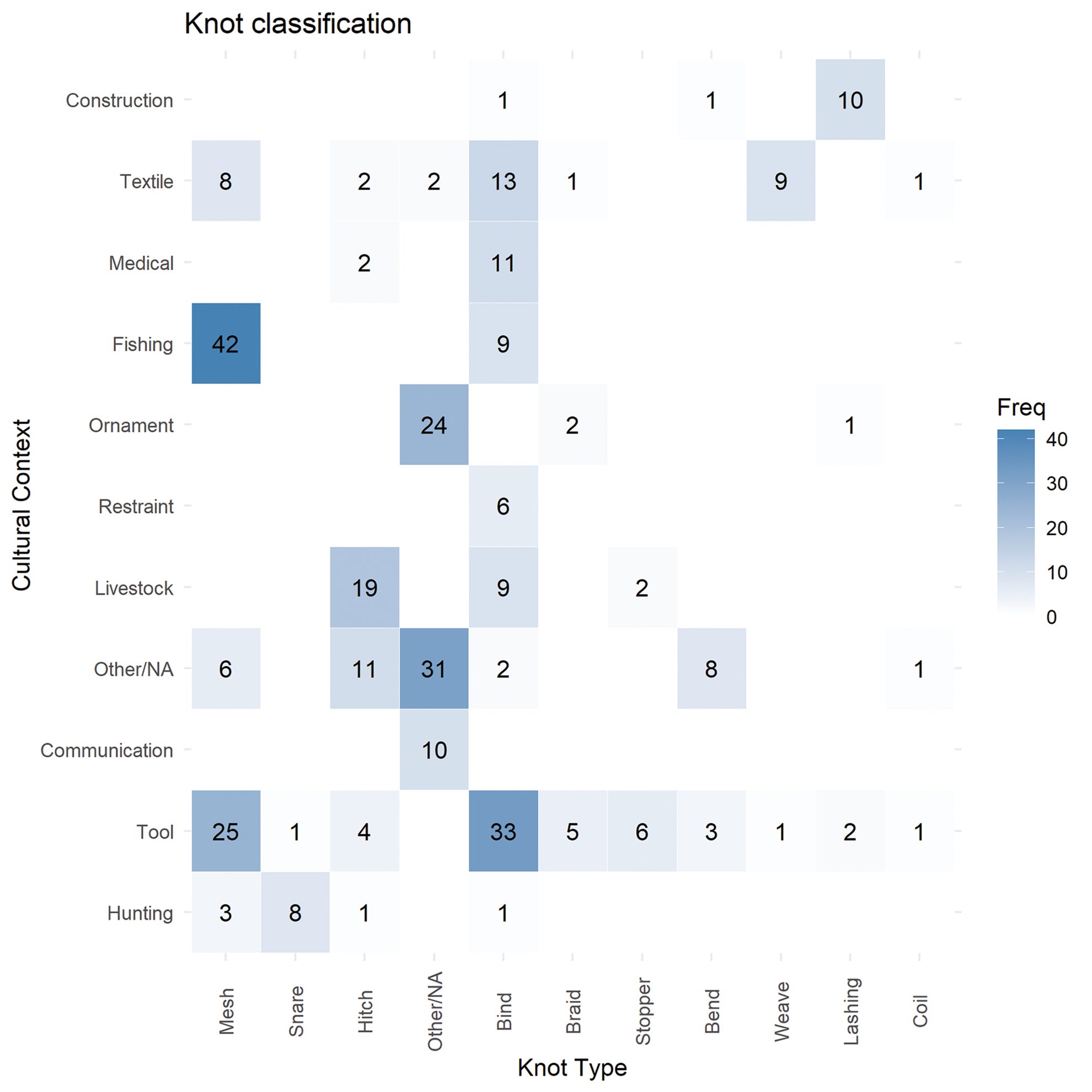
Decorative applications of knots show much wider experimentation. Within the eleven applications studied, the most abundant knot artifacts found were for fishing nets, then for tool use, and then for decoration. Of the knot classifications used by the study, decorative knots had the highest variation in style. For thousands of years, there has been creative expression through knotted cords.
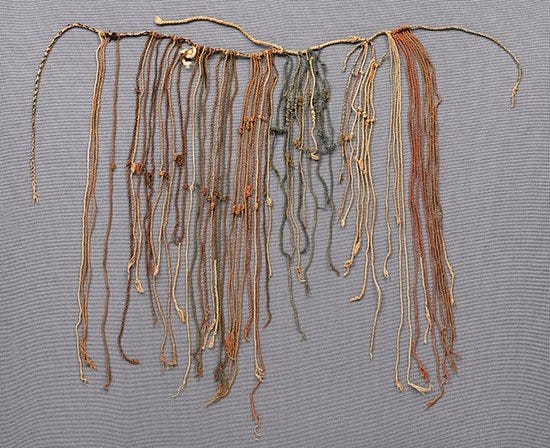
There are uses of knots no longer in fashion, including an Incan form of record keeping. Deserving of its own examination elsewhere, quipu is the practice of encoding numbers and possibly even phonetics into knotted string. Our ability to decode this system is far from perfect, and shows simple technology can be implemented to solve more complex problems than we might currently imagine.
While some societies portray higher levels of experimentation with knot structures than others, societies overall appear to have experimented less with practical knots than with, for instance, the more playful string figures. This suggests that a staple multi-purpose corpus of reliable knots has been good enough for the bulk of quotidian pre-industrial purposes, easy to transmit accurately through social learning, or that the failproof nature of knots has precluded experimentation. ~Kaaronen et al. 2015
Knots of the Future
The Ashley Book of Knots (helpfully included among suggested readings by the Boy Scouts) contains over 3800 examples. I think I know two.
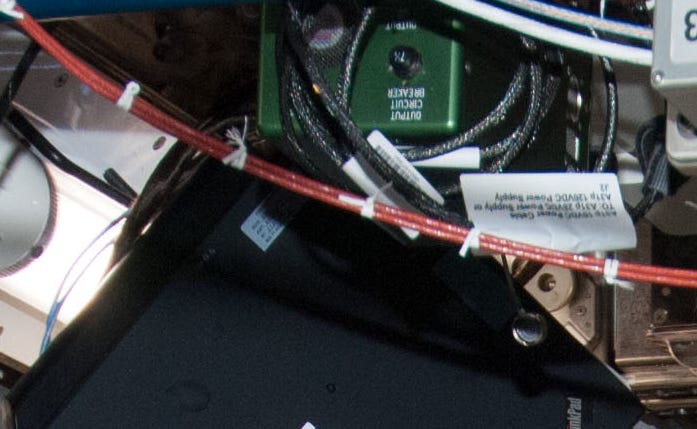
I find it hard to say we will discover many new knots in the future; or that these discoveries should revolutionize our world. I doubt the most used knots of the year 3000 will be different than today. On the International Space Station, knots are tied by astronauts for all the same reasons you and I encounter daily.
On the deck of a starship bound for the stars there will still be ropes. Perhaps a sailor of Odysseus would not be so lost among the masts of our descendants. Our ancestors could untie our nets on a Martian sea, and help hold down what the Earth-like wind would blow away.
There are technologies we will always find a use for; there are ties stronger than others.
Kaaronen RO, Henrich AK, Manninen MA, et al. The Ties That Bind: Computational, Cross-cultural Analyses of Knots Reveal Their Cultural Evolutionary History and Significance. Cambridge Archaeological Journal. 2025;35(3):472-488. doi:10.1017/S0959774325000071
Excellent piece Max!
Reading this made me think of the decorative knot and seal found on the door to Tutankhamun's tomb in 1922. Undisturbed for 3200 years https://rarehistoricalphotos.com/unbroken-seal-tutankhamun-tomb-1922/